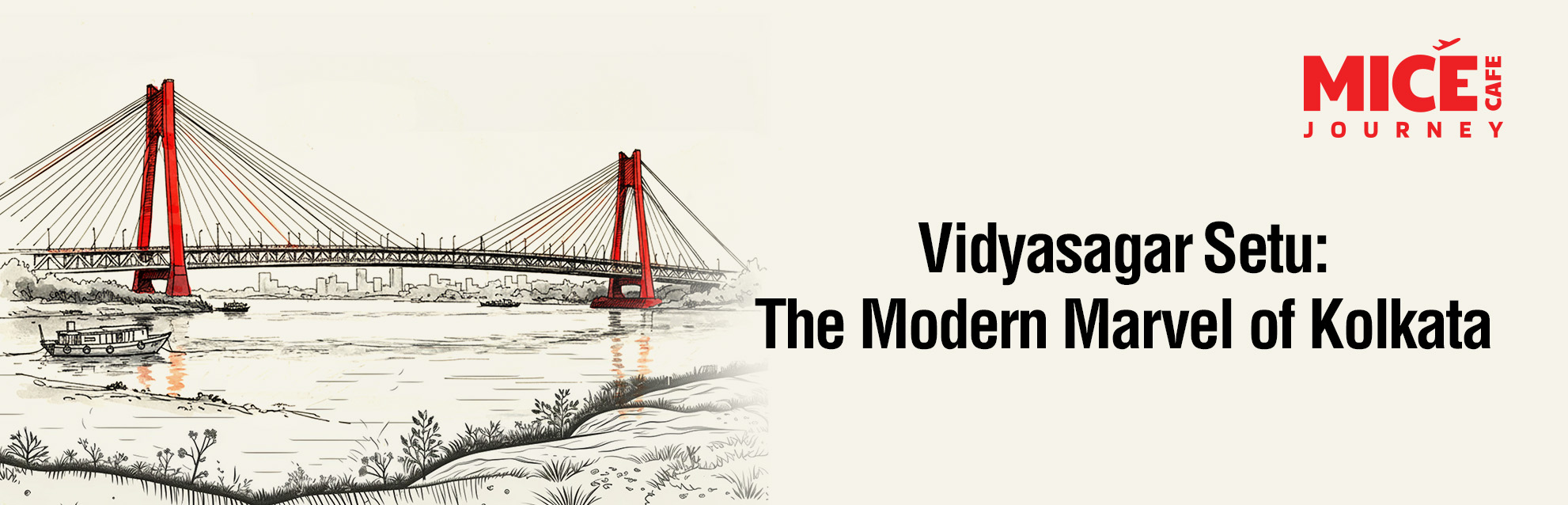
Vidyasagar Setu: The Modern Marvel of Kolkata
The Vidyasagar Setu, also known as the Second Hooghly Bridge, rises in a striking silhouette over the Hooghly River, connecting Kolkata with Howrah through a bold and contemporary design. Named after the 19th-century Bengali reformer and educationist Pandit Ishwar Chandra Vidyasagar, the bridge represents Kolkata’s transition into a modern metropolis while honouring its intellectual heritage.
Just a few kilometres downstream from the iconic Howrah Bridge, Vidyasagar Setu is a symbol of capacity, speed and efficiency — a perfect complement to the older structure’s emotional and historic weight.
By the mid-20th century, Kolkata’s rapidly growing population and traffic were almost entirely dependent on Howrah Bridge. The strain on a single river crossing began to affect movement, trade and daily life between Kolkata and Howrah.
In the 1960s, the concept of a second Hooghly bridge took shape — one that would carry higher volumes of traffic, ease pressure on Howrah Bridge and support the city’s expansion towards the south and the western suburbs.
Construction of Vidyasagar Setu began in 1978 under the supervision of the Hooghly River Bridge Commissioners (HRBC). The project faced formidable challenges: heavy river traffic, complex soil and foundation conditions and the technical demands of a new-generation bridge.
After years of engineering effort, Vidyasagar Setu opened to the public on 10 October 1992. At the time of its inauguration, it was India’s longest cable-stayed bridge, and it remains one of the country’s most significant modern infrastructure achievements.
Vidyasagar Setu is a cable-stayed bridge — structurally distinct from the truss design of Howrah Bridge. Clean lines, tall pylons and a fan of steel cables give it a futuristic presence against the skyline.
Key design features include:
The cable-stayed system allows loads to be transferred directly to the pylons, giving the bridge a sleek, open structure and a strong, stable profile suitable for high-volume vehicular movement.
Vidyasagar Setu is as visually impressive as it is functional. Its tall pylons, cables and sweeping deck create a modern counterpoint to Kolkata’s older colonial and traditional architecture.
While Howrah Bridge remains the emotional heart of the city, Vidyasagar Setu functions as its modern backbone, carrying much of the city’s vehicular traffic and enabling smoother logistics.
For corporate and MICE travellers, Vidyasagar Setu is more than a road bridge — it is a statement about infrastructure, planning and future readiness. It is particularly impactful for delegations focused on:
MICEcafe Journey can design itineraries in Kolkata where Vidyasagar Setu:
Together, Howrah Bridge and Vidyasagar Setu tell Kolkata’s twin story — heritage and modernity, nostalgia and momentum. While Howrah Bridge reflects the grit and character of early 20th-century engineering, Vidyasagar Setu signals the city’s ability to deliver complex projects for a new era.
For corporate groups, Vidyasagar Setu is a reminder that strong foundations, smart planning and bold vision can transform how a city lives and moves.
With MICEcafe Journey managing routes, venues, logistics and experiences, your December programme in Kolkata can weave together both its legendary bridges — ending your Bridges of Cinema calendar year on a truly powerful and symbolic note.