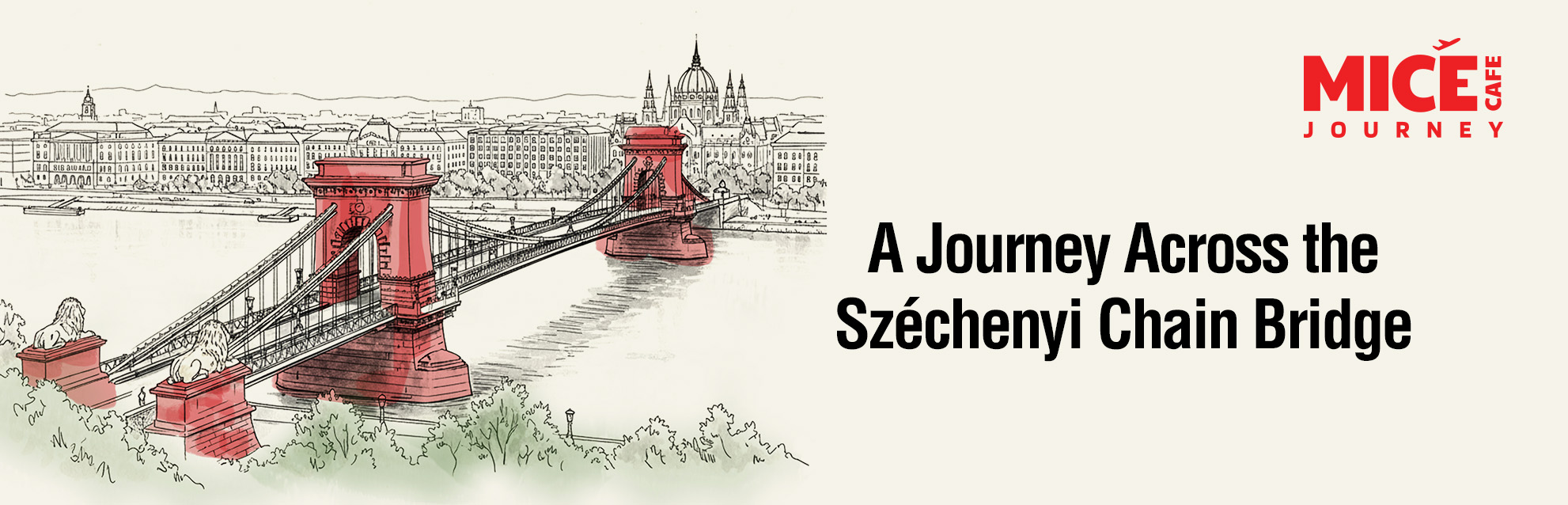
A Journey Across the Széchenyi Chain Bridge
Few structures capture the spirit of a city the way the Széchenyi Chain Bridge does for Budapest. Arching gracefully over the majestic Danube River, this historic landmark is more than a bridge — it is a symbol of unity, progress and architectural brilliance.
For travellers seeking to experience Budapest’s true essence, the Chain Bridge is an unmissable part of the story. At MICEcafe Journey, where we craft memorable travel experiences and destination insights, we spotlight this European treasure as an inspiring highlight for corporate and incentive groups.
The idea for a permanent bridge across the Danube came from one of Hungary’s greatest statesmen: Count István Széchenyi, often called “The Greatest Hungarian”. According to legend, his determination was sparked when he was unable to cross the river in winter to attend his father’s funeral due to ice blocking the ferries.
Recognising the need for a reliable, permanent connection between Buda and Pest, he championed what would become the first permanent bridge across the Danube in Hungary.
Construction began in 1839 under English engineer William Tierney Clark and Scottish engineer Adam Clark (no relation), who oversaw the project on-site. When the bridge opened in 1849, it stood as a powerful symbol of progress, modern engineering and national pride — a meaning it still carries today.
The Széchenyi Chain Bridge is a masterpiece of 19th-century engineering. Its distinctive iron chains, solid stone pillars and classical proportions give it a timeless silhouette recognised around the world.
At each end, two imposing lion statues, sculpted by János Marschalkó, guard the bridge — among the most photographed icons in Budapest. Many visitors believe the lions have no tongues, but look closely and you’ll see they do!
Stretching 375 metres across the Danube, the bridge is not the longest in Europe, but what it lacks in length it makes up for in historic weight and visual drama. By day, it offers a scenic link between the bustling city streets of Pest and the castle-topped hills of Buda; by night, glowing in golden lights, it becomes a spectacular reflection over the water.
Over its long life, the Chain Bridge has seen triumphs, turmoil and rebirth. During World War II, retreating German forces destroyed the bridge, leaving only the stone pillars standing. Its symbolic importance, however, ensured that reconstruction began soon after the war.
In 1949, exactly 100 years after its original opening, the rebuilt bridge was inaugurated once again — a powerful moment of resilience and continuity for the Hungarian people.
In recent years, the bridge has undergone further renovation to preserve its structural integrity and enhance its appearance, ensuring that future generations of locals and travellers can continue to enjoy its timeless charm.
One of the Chain Bridge’s greatest strengths is its location. It serves not just as a physical link, but as the perfect gateway to some of Budapest’s most iconic attractions.
On the Pest side, you are close to:
On the Buda side, just across the bridge, you are moments from:
Standing at the midpoint of the bridge, you can turn in any direction and take in some of Europe’s most memorable riverside scenery.
At MICEcafe Journey, we believe travel is more than movement — it is storytelling. The Széchenyi Chain Bridge is a perfect example of the kind of destination we love to feature: rich in meaning, beautiful to behold and unforgettable in presence.
For corporate groups, the bridge can become:
Integrated into a broader Budapest itinerary, it helps set the tone for a programme built around culture, history and connection.