
February 2027
Across a World of Cultures
Ibn Battuta · Africa, Arabia & Asia
- When
- 1325-1354
- Journey
- Desert & architecture
- Travel it today
- Morocco
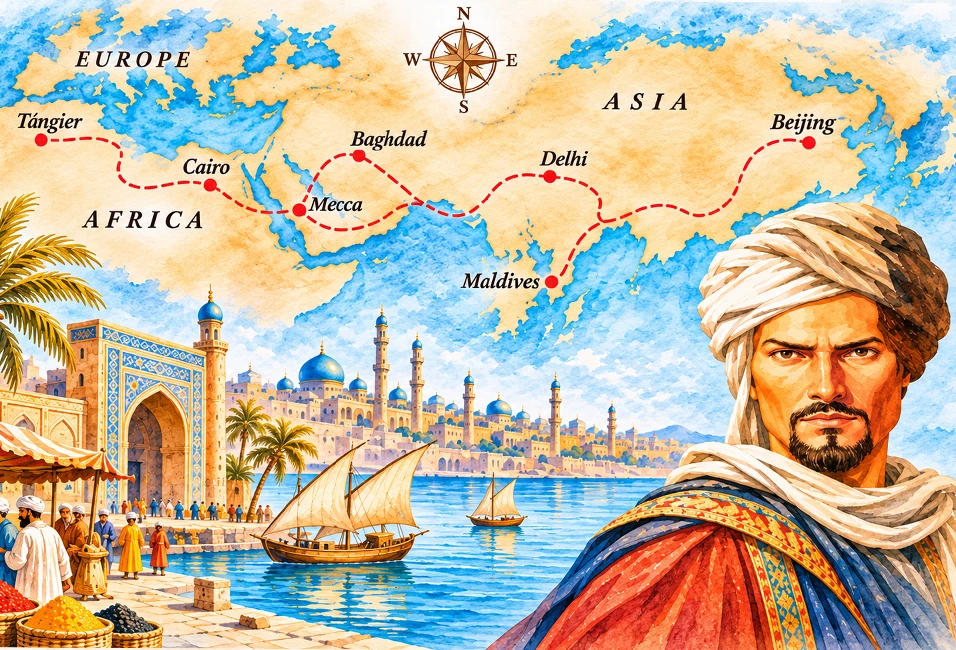
Ibn Battuta left Tangier in 1325 intending to make the Hajj. He returned roughly thirty years later, having covered more ground than any traveller of his era — and possibly more than anyone before the modern age.
A pilgrimage that kept going
Battuta was a young scholar of law when he set out alone for Mecca. Having completed the pilgrimage, he simply carried on — through Persia, East Africa, Anatolia, Central Asia, India, the Maldives and, by his account, as far as China.
He worked as a judge in Delhi and in the Maldives, which is part of what made the journey possible: his legal training was a portable profession across the Islamic world.
The Rihla
On his return, the Sultan of Morocco commissioned a written account. The result, usually called the Rihla, was dictated to the scholar Ibn Juzayy and remains an extraordinary record of fourteenth-century cities, courts, markets and customs.
What makes it valuable is not just the distance covered but the detail: what people ate, how they traded, what they argued about.
Following the thread today
Morocco is the natural starting point. Fez and Marrakech still hold the madrasas, souks and courtyard riads that shaped his early world, and Tangier — his birthplace — looks across to Spain from the Strait.
Beyond Morocco, the route reaches into Oman, Zanzibar and the Maldives, each of which preserves a piece of the Indian Ocean world he described.
Destination highlights
What a group actually sees on the ground in Morocco.
-
Al-Qarawiyyin and the Fez medina
A working scholarly quarter, and the walled city Ibn Battuta grew up beside.
-
Jemaa el-Fnaa, Marrakech
The square that still runs as a nightly market, as the Rihla describes such places.
-
Tangier and the Strait
His birthplace, looking across to Spain from the African shore.
-
Erg Chebbi dunes
Desert camp country, and the most reliable incentive evening in Morocco.