
January 2027
The Road That Connected East and West
Marco Polo · China & the Silk Road
- When
- c. 1271-1295
- Journey
- Overland caravan
- Travel it today
- Uzbekistan & Xi'an
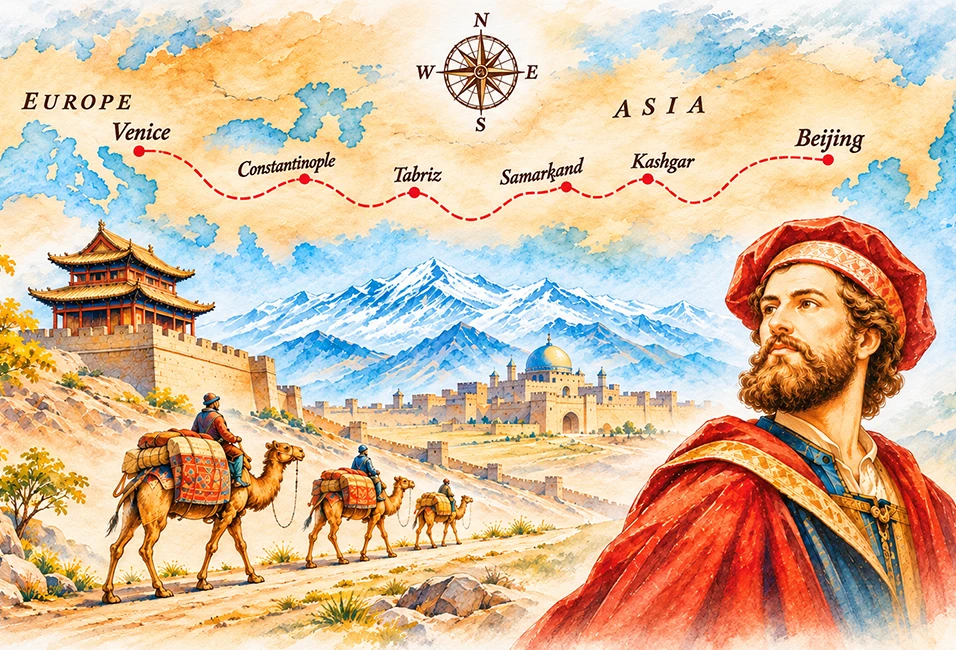
Long before the first sea routes to Asia, the Silk Road carried silk, spices, paper and ideas between the Mediterranean and China. Marco Polo did not open that road — he travelled a network that had been working for centuries — but the account of his journey brought it vividly into European imagination.
A merchant family on the move
Marco Polo left Venice around 1271 as a teenager, travelling with his father and uncle, both experienced merchants. Their route ran overland through Persia and Central Asia towards the court of Kublai Khan, a journey measured in years rather than weeks.
He remained in Asia for more than two decades. The book that followed, known as Il Milione or The Travels, was dictated after his return and became one of the most widely read travel accounts in medieval Europe.
A route, not a single road
The Silk Road was never one highway. It was a shifting web of caravan tracks, mountain passes, river crossings and oasis cities, each stage handled by traders who rarely travelled the whole distance themselves. Goods changed hands many times between Chang'an and the Mediterranean.
Samarkand, Bukhara, Kashgar and Dunhuang grew wealthy as the junctions of that web — and the architecture they built with that wealth is still the reason travellers go today.
Travelling the route now
Uzbekistan has become the most accessible way to walk a stretch of the Silk Road. Samarkand's Registan, the necropolis at Shah-i-Zinda and the trading domes of Bukhara sit within easy reach of one another, with a high-speed rail link between the main cities.
Further east, Xi'an marks the Chinese end of the overland route, with the Terracotta Army and the old Muslim Quarter within the city walls.
Destination highlights
What a group actually sees on the ground in Uzbekistan & Xi'an.
-
Registan, Samarkand
Three madrasas around one public square, the set piece of Timurid Samarkand.
-
Shah-i-Zinda
A corridor of tiled mausoleums, among the finest ceramic work in Central Asia.
-
Po-i-Kalyan and the trading domes, Bukhara
Minaret, mosque and the covered bazaars where caravan goods changed hands.
-
Terracotta Army, Xi'an
The Chinese end of the overland route, inside the old city walls.